Showing posts with label masterpiece. Show all posts

Saturday, May 16, 2015

Mad Max: Fury Road Review


"If I'm gonna die, I'm gonna die historic on a fury road!"

That quote covers so much about this film in such a small amount of words. The death toll elevates, the action is furious and my goodness the movie feels historic. Now hold on, don't roll your eyes at me. Yes you did, I could see you. I know what you are thinking, here he comes with some of that instant reaction hyperbole bullshit, using a word like historic, so let me be clear: no, Mad Max: Fury Road is not one of the greatest films of all time. 

One of the greatest action films of all time though? Yep, I can and will say that without even a fraction of doubt in my body. This is easily one of my favorite genre films ever made. I was battered, bruised and pummeled into submission by the relentless lunacy on display, all while sitting in a leather recliner and sipping a giant soda. I felt physically exhausted by the end of a two hour cinematic experience, and yet that only represents a fraction of why I loved the picture so much. 
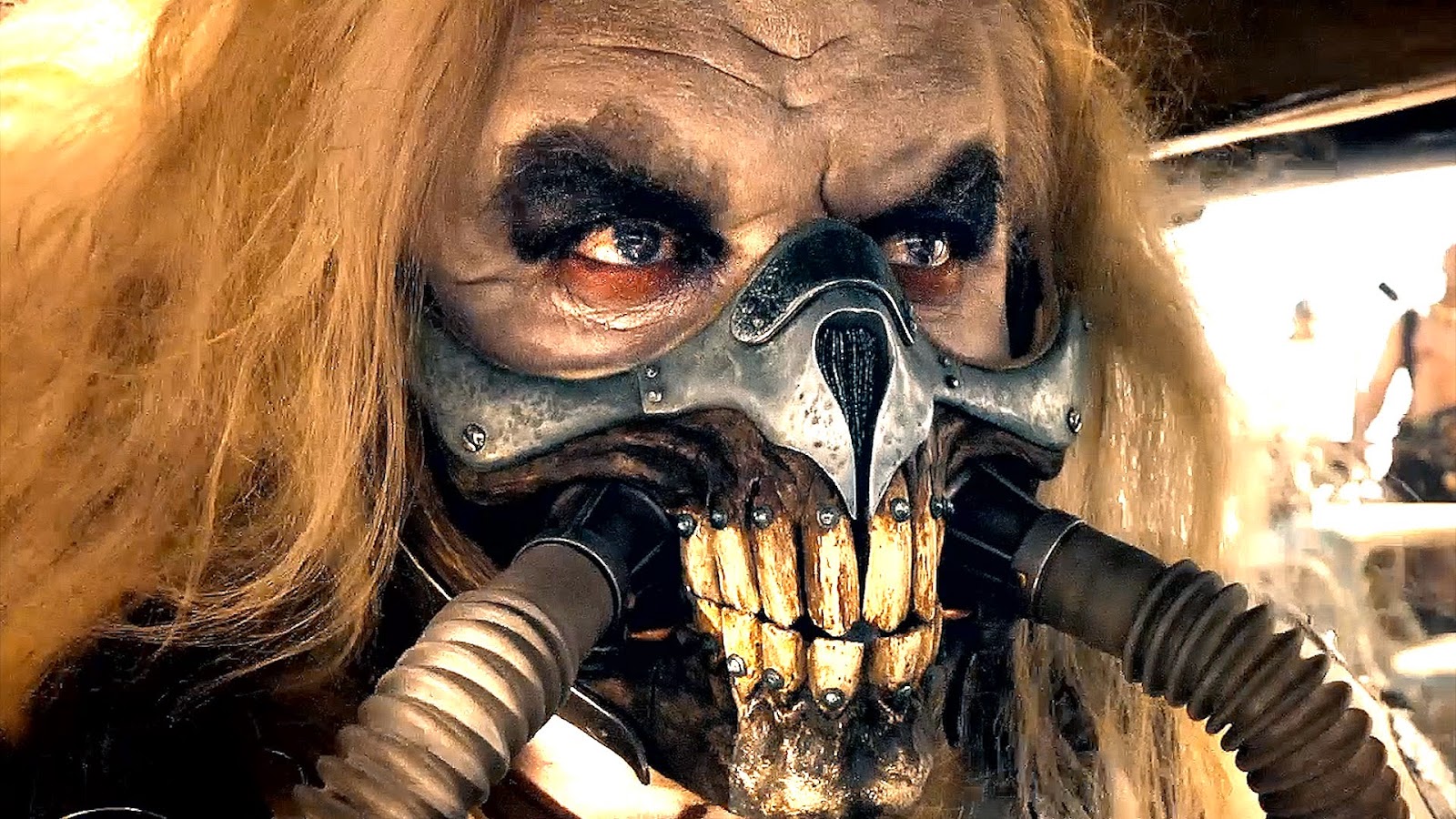


George Miller has created an post apocalyptic punk rock masterpiece that left me in awe on numerous occasions. It isn't merely the general concept of the action being cool or non-stop, it's the way the material was handled. The frenzy is directed with such silky smooth confidence that even when the chaos seems completely out of hand, we are able to follow exactly what is happening as clear as day. The set pieces are extraordinary and as imaginative as I have ever seen. I literally said the single word "Wow" aloud to myself on multiple occasions, all while flashing a giant, shit eatin' grin on my face throughout every damn minute. Seriously, when I buy this on Blu-ray, and that's a when, not an if, I may break the player with how many times I am going to give it a spin. Just the thought of being able to dig into some special features regarding how the hell Miller filmed some of these sequences makes me excited for future me.

Despite the praise I laid out above, had it merely been just an action extravaganza I wouldn't be busting out a word like masterpiece. While the intensity of Mad Max: Fury Road is what people will show up for (and I don't blame them one bit), where this films truly excels are those quiet sequences that give us a breather, showcasing some of the finest character development I have seen based on the very small amount of words actually used to achieve it. Charlize Theron deserves an honorary Oscar for her eyes alone, the type of award that would have been handed out long ago during the silent era of cinema, which is rather ironic considering just how modern and loud this puppy is. Her character is named Furiosa and she is a bad ass force to be reckoned with, but in her eyes we get to know her pain. We get to witness her passion. We get to see her soul.


Actually, I can't write this review without addressing another pile of praise that deserves to be heaped towards Mr. Miller and his expert craft of this film. Bless him for truly making a picture that shows how much ass women can kick. She may be too young now, but someday I would be proud to sit my daughter down and allow her to soak in the carnage on display as females are depicted as not just strong, but capable of killing every last mother fucker that gets in their way. Far too often the action genre depicts a woman as a damsel in distress, needing a man to swoop in and save her as she appears weak and fragile rather than courageous and tough. Mad Max: Fury Road gives us women who make us believe they can drop our asses if we try to stop them, and I applaud the hell out of George Miller, Brendan McCarthy and Nick Lathouris for penning a screenplay that subverts the traditional misguided tropes. 

If you are like me, you saw the overwhelmingly positive critical response to this film and couldn't believe your eyes. I wondered how an action film could be so universally praised, as usually the genre is deemed derivative. I no longer wonder. It is worthy of the accolades. With a musical score that blasts through your body, a brilliantly subtle screenplay that achieves so much by doing so little and quite possibly the greatest action ever put to celluloid, Mad Max: Fury Road is a roaring, thunderous achievement. 


5/5 


Saturday, April 25, 2015

Andrei Rublev Review


People always say "You can do anything you set your mind to", but is that really accurate? Could I have pursued a multitude of professions when I was growing up and determining a path for my education? Certainly. Could I have worked harder, maintained a stronger focus on my goals and been at the top of my class? Sure. It is amazing what a person can achieve when they know what they have to do to get to where they want to be.

Yet I still don't truly believe the word "anything" belongs in that first quote. Some people can work night and day and become great, but it takes more than that to be a genius of a craft. I was pretty good at basketball growing up, but no matter how hard I practiced, no matter how many shots I took, I was never going to be Michael Jordan. I also had a pretty strong knack for golf. At one point I was even the Captain of my high school team, but no matter how many rounds I played, I was never going to be Tiger Woods.

I bring this up because some films take me to a place that resides far beyond words like admiration or fondness or even love. Sometimes I will watch a work and my first reaction is one of jealousy because I think to myself, "Why couldn't I be capable of making something like this?". I was born in April, the year 1984 and by the time I took my first breathe I honestly believe it had already been decided: I was never going to be Andrei Tarkovsky. Only a few men in the history of cinema even play in the same league. Some people are just born with a gift that is hard to comprehend.


There is a level of brilliance on display during every minute of the epic picture Andrei Rublev that is difficult to even put into words, and there are a lot of minutes to analyze along the way. Clocking in at well over 3 hours in length, deciding to sit down and devote not only your time but also the mental energy it takes to devour such a movie can be daunting. Trust me though, it is worth it. 

Despite the fact that obviously we are not watching real footage from 600 years ago, Tarkovsky manages to create some authenticity with a sometimes crude and dated look to the film, but this isn't a flaw, it is actually quite stunning. Typically when I see a period piece taking place during a similar time, I can't help but see it as a Hollywood picture attempting to capture a realism that is impossible to create. Tarkovsky somehow transports us back to an era long before a camera could even be there to film. Everything seems to be lit naturally, something that is especially noticeable during sequences taking place indoors, when a face is shrouded in shadows only to be illuminated by the flicker of light from a candle. No matter how dull and dour and grey and cold the image appears to be on screen, it is consistently beautiful to look at.

The screenplay, written by Tarkovsky and his co-writer Andrei Konchalovsky, took more than two years to put together and the time and effort is not lost on me as I witnessed this epic masterpiece unfold. Every word feels perfect and they are all delivered by an expansive and flawlessly assembled cast of unknown actors. As an audience, we may not literally see all of the work that goes into the entire craft of a film but often times we can feel it. Modern day studios try to churn out films and their sequels year after year, and you can sometimes sense that they were rushed. The focus was on box office receipts rather than art. Andrei Rublev is the antithesis of this mentality. You can practically soak in the amount of passion that went into every single frame.


I was once asked why I would root for Tiger Woods at a time when he was winning practically every tournament he played in. "I love to watch greatness at its absolute best.", I responded. 

That's exactly how I felt as I experienced Andrei Rublev. 


5/5


Sunday, April 5, 2015

Autumn Sonata Review


I'm not gonna pretend I have seen all of his films or have even truly scratched the surface of those I have, but I think it is pretty clear that Ingmar Bergman was a fucking genius.

I apologize for using such vulgarities in the opening sentence, but I needed a word to really drive home my point, and the one I went with was pretty darn appropriate. Merely calling him a genius doesn't feel right. People throw that word around these days without truly considering what it means. I once heard a guy call his buddy a genius for putting french fries on top of his hamburger. No, Bergman was a fucking genius. He is worthy of the word in so many ways that rise far above a greasy potato being stacked on top of a greasy slab of meat.

Autumn Sonata is an intense, powerful, painful film that focuses on a broken relationship between a mother (Ingrid Bergman) and her daughter (Liv Ullmann), and could be used as an instructional video for actors trying to learn how to portray real, honest emotion. This is a flat out masterpiece, the kind of work that leaves you shaken and in awe of what took place. Autumn Sonata thrives because of its minimalism, and that is the true masterstroke from Ingmar Bergman. He doesn't need to throw anything flashy or inherently exciting at you to keep the audience on its toes. It's a flashy film because of the amazing screenplay, seemingly simple yet confidently brilliant direction and performances that will make your jaw drop to the floor. It's exciting because at some point during Autumn Sonata I realized how uncomfortable and devastatingly believable the whole thing is, and it works. It works so damn well.


Stop calling your friend a genius for combining multiple foods into a single bite, or for taking a short cut to get you to a store 3 minutes faster than normal. Genius is a word that should describe something or someone whom created something profoundly smart, at a level that a vast majority of the population could never dream of achieving. Ingmar Bergman is a genius and Autumn Sonata might be the best thing he has ever done.


5/5


Saturday, February 7, 2015

Winter Sleep Review


A lyrical masterpiece from the cinematic mind of Nuri Bilge Ceylan, it will be easy and unfortunately understandable if a film like Winter Sleep doesn't achieve the recognition and level of appreciation it deserves. At first glance, I would expect most to avoid a work like this merely based on it's 196 minute length and the fact that it is a Turkish film with subtitles, but please don't. If I can convince even just one person to find the time and have the patience to digest this achievement, it will be a victory in my book. Winter Sleep is easily one of the finest efforts of 2014.

First, let me get this out of the way: The LEGO Movie is no longer the biggest, most confounding exclusion from the Academy Award nominations. If it were up to me, Winter Sleep would not only be nominated for the Best Foreign Feature, it would be the clear cut winner, yet despite winning the Palme d'Or at the Cannes Film Festival a year ago somehow this was overlooked by the Academy. Last year anonymous voting members admitted that they didn't want to watch the masterful 12 Years a Slave because heaven forbid they have to tap into their white guilt, as if two hours of their time was as difficult of an experience as the lives of those depicted in that film. While 12 Years a Slave and Winter Sleep aren't even remotely comparable films, I bring this up to make a bigger point: it's a shameful thing that those who are asked to award recognition to the most worthy movies from a year don't like to be challenged. I can only assume that too many people looked at those 196 minutes and didn't even give this beauty a chance. 


Aydin (Haluk Bilginer) is a former actor who now runs a small, picturesque hotel with his beautiful young wife Nihal (Melisa Sozen) and his recently divorced sister Necla (Demet Akbag), and his relationship with both of them is complicated to say the least. Despite his less than ideal circumstances with the family that surrounds him each day, Aydin still leads an enviable and idyllic life compared to those around him in the region. He is well educated, he is wealthy, and he admires the breathtaking landscapes that surround his hotel as he writes columns for the local newspaper and also assembles the research needed to write a book. Aydin is also the landlord for various citizens in the area and despite the tough economic times that surround him, he shows very little empathy for the less fortunate. He discusses his many charitable donations and likes to believe he is a man of the people, but when literally faced with someone who is struggling to avoid losing his home, he is quick to dismiss him claiming there is nothing he can do.

Much like the hotel he owns and occupies, Aydin looks down on those below him.

Winter Sleep is a film that is driven by incredibly written dialogue, as not a word feels wasted or irrelevant to the greater goal of the narrative. Some sequences are long and deeply personal, heated interactions between Aydin and Nihal or Aydin and Necla inside the hotel, and some may grow weary of the extended nature of these conversations but I was amazed at the way these actors working with such heartfelt, heavy material never skipped a beat. The ensemble as a whole delivers some of the finest work on screen of 2014, as these faces that were unknown to me prior to this film absolutely blew me away with their nuance, the subtle power they were able to deliver at every moment. Melisa Sozen as Nihal, the wife of Aydin who lives a seemingly blessed life without financial worry yet she wants more from existence, might be the strongest of the bunch. It was flat out impossible not to pay attention when she was on screen, as every look and expression and word demanded that I take notice. Many would dream to be Nihal yet she craves a feeling of independence that is impossible under that roof. She may reside up above the many struggling people nearby but just like them, she is looked down upon from the man who owns it all. When tears fall from her eyes, it was as if I too was experiencing the pain.


Featuring gorgeous, lush cinematography and lighting that practically made me drool in delight, the snowy landscapes of the region were only a small portion of what makes Winter Sleep such a treat for the eyes. The frames that were really a joy to admire took place indoors, both inside the hotel and even the run down residence of the nearby struggling family in search of a way to avoid eviction. The flicker of a fireplace against their faces and the way it warms up a scene that is freezing cold in ways beyond what is influenced by weather is pure magic. 

Every aspect of this masterwork proved to be essential to the overall experience being pretty much perfect, and the final act features multiple moments that literally gave me chills. Winter Sleep is long but I never felt even the slightest drag, as I was sucked into this superb character study from beginning to end. I am just about ready to wrap up my 2014 cinematic calendar and put out my best of list, and what a brilliant way to close it up. Without a doubt, Winter Sleep will be found near the top.


5/5

Friday, July 25, 2014

La Jetee Review


I have never understood the fascination with the nostalgic power of photographs. I encounter so many people who have an obsession with documenting every banal moment of their lives with pictures, stopping in their tracks to pose outside a frozen yogurt shop or while they are eating a slice of pizza. The worst part is that they think I care, but I don't. Don't show me 150 still images of the same seven people smiling at a camera from different angles. Don't even show me one of those images. Being totally honest, zero percent of me cares to see the picture and zero percent of me cares to be in such a picture. All I need is my memories, whether they be of the most mundane, seemingly insignificant segments of my life or of a monumental moment that changed everything.

I had absolutely no idea what style of storytelling would be portrayed during the much lauded 1962 science fiction masterpiece La Jetee, and I was surprised to find that essentially it is my worst social nightmare presented cinematically. For a brief 28 minutes, an entire narrative is presented almost exclusively through a series of still images and a voice-over, and my goodness is it incredible. Telling the story of an attempt to time travel after the ramifications of nuclear war left Paris devastated, I was completely captivated by the format of the film and floored by the results. 


The most fascinating and important slide show of photographs I have ever witnessed. If only my family and friends could present their weekend getaway in such an inspired fashion.


5/5

Tuesday, July 15, 2014

Cloud Atlas Review


In the world of film criticism, the word perfect is tossed around a lot, but honestly, what defines a perfect film? How can one truly gauge something like perfection?

To be clear, I am just as guilty of invoking the word as anyone else, mostly to illustrate that an aspect or an entire work felt perfect to me personally. Even then though, how can I be so sure? The Tree of Life is a cinematic experience that is so sublime, so richly rewarding for my soul that I could never actually find a flaw, but does that mean one doesn't exist? Isn't it always possible something technically could be improved upon, even if we aren't able to spot the imperfection no matter how close we look?

Cloud Atlas isn't a perfect film, not even for me on a personal level. I find the flaws to be minor, but they expose themselves nonetheless. Six stories that take place at vastly different times are weaved together to form a cohesive narrative, and some of these characters and their personal journeys are more interesting and impressive than others, yet as a whole work this is a film that resides inside my top 30 of all time and climbs slowly higher and higher with each revisit. I tend to believe the reason I formed this deep, important connection to Cloud Atlas boils down to a matter of personal preference more than anything else.


Some may admire a more minimalist feature that expertly knows its limitations and embraces them, and that is totally fine and understandable. For me though, if you really want to get my film loving juices flowing, sit me down in front of a work that is willing to make a few mistakes in pursuit of grand, massive ambitions. The scope of Cloud Atlas is on a level I have never witnessed before in cinema, a film that aspires for true greatness and for some I am sure it falls short. Not me though. I passionately connected to not only the concept and thematic messages of the film, but also the fact that it soars to seemingly unreachable heights on a technical level.

When I read the novel of the same name that this film is adapted from, I understood why it was considered by many to be a work that simply could not be translated to the screen. I found the novel by author David Mitchell to be a literary masterpiece, a challenging read that will reward the persistence of those who are willing to commit to its innovative format in the end, but I sensed that an attempt by the Wachowskis and Tom Tykwer would end up being a rather unfortunate failure. I was wrong, so very very wrong, and I discovered this in an IMAX theater on opening weekend when the fastest cinematic three hours of my life floored me and left me wanting to go back and do it again and again.

This being my fourth viewing overall of the film, I still can't wrap my mind around what an achievement the editing of Cloud Atlas is. The novel separated the six different stories which allowed me to mentally focus on only the one in front of me, only the words I was currently reading, and then I would put the book down to take a minute and piece together the thematic and literal connections that linked one story to the next. The reason it felt nearly impossible for the source material to be coherently adapted was essentially, how do you present such material to those that are not familiar with the stories in advance? If you keep the format the same and focus on one set of characters at a time, you risk losing the audience during the segments that are deemed less compelling, but to attempt to weave through the past, the present and the future all at once seemed destined to befuddle an audience that entered the cinema with no prior knowledge, unprepared for what awaits them. I am in awe of how seamlessly the film is pieced together, as I find from beginning to end it takes on an almost lyrical flow that overwhelms me with joy.


If someone were to ask me for a definition of pacing that I find ideal, I would turn to Cloud Atlas and point to the intimidating running time on paper and challenge them to actually feel any sluggish moments, any fat they would trim due to boredom. I have seen films that are literally half the length of this that bore me to tears, forcing me to check the clock on the wall and beg for the hands to move a bit faster. When I watch Cloud Atlas, clocks don't exist. Time is rendered meaningless. All that matters is what is in front of me, a work that defines epic, a work that even at its silliest lows, it is still utterly fascinating.

Cloud Atlas certainly isn't perfect, but I'm not sure any film really is. Considering its ambitions and the fact that practically every single second of this wonder had me glued to the screen, I don't search for nor need perfection. I am thankful of anything bold, exciting, and unique that will resonate in my mind and heart for the rest of my life, and without a doubt this is a work that has cemented its spot forever.


5/5

Saturday, May 31, 2014

Take Shelter Review


My wife of 8 years is currently working on her master's degree, having the courage to go back and change the course of her life by pursuing a career in something she cares deeply about. Words can hardly describe how much I admire this, as I sit at a job each day that doesn't elicit even the slightest bit of passion from me, merely a countdown of hours, minutes, seconds until I can exit the building and pretend it doesn't exist. Her goal is to enter the world of social work, a focus on mental health, a fascination with trying to understand it and also the desire to show compassion for those suffering through such internal devastation.

The other day, she mentioned that an upcoming paper would be regarding the portrayal of mental health in a film, and a modern masterpiece immediately came to mind as the perfect subject matter for such an assignment. Take Shelter, the 2011 independent drama by the young auteur Jeff Nichols, is a work of extraordinary power and spellbinding performances, a tour de force master class in filmmaking that was even more stunning during this, my second viewing. The film follows a young family of three living a seemingly normal life in rural America, with one of the finest actors working today playing the role of Curtis, a hard working husband and father doing what he can to support a beautiful wife and daughter, the latter unfortunately having lost her ability to hear. Samantha, the wife and mother, is played by the amazing Jessica Chastain with strength and grace, an astonishing resiliency through tough times, a life of calm happiness shattered by the dreaded approaching storm.


Curtis begins experiencing nightmares littered with apocalyptic visions and moments of shocking violence involving the people he loves most, and the effects of these dreams carry over into his conscious reality. The striking thing about the unstable mind of Curtis is that he is aware enough to recognize the timing of this unfortunate progression, the realization that his mother began fighting a similar battle at the same age yet he can't stop himself from fearing the destructive storm that he believes is headed their way. Curtis risks everything, his job, his financial well being and worst of all his family as he becomes obsessed with building an elaborate storm shelter to ensure their safety.

I am an optimistic film enthusiast, as I enter every single work hoping to find aspects to embrace and often times I do, but what I feel is most often missing from our current cinematic world that revolves around massive budgets and box office receipts is the importance of storytelling. It seems so simple, the concept that a film is meant to deliver a compelling story to the audience, yet far too often a film will lack any semblance of this. Jeff Nichols understands what it truly means to take an audience on a journey, to form a deep connection with setting and atmosphere and characters, and his ability to deliver a narrative with patience and maturity without ever bringing us across the line into boredom is humbling and inspiring. What he delivered here with Take Shelter is flawless, a film that has all the makings of a true classic to be cherished for decades to come.


Plenty of films have been centered around mental illness, but rarely are they this emotionally draining and this expertly crafted. Nichols fabulously showcases the fact that Curtis may be suffering from the disease, but he is not the only victim of such a tragedy. The journey Samantha goes on during these perfectly paced two hours is one filled with heartbreak, with certain sequences being so emotionally draining that I wished I could crawl through the screen and just give her a damn hug, tell her everything would be alright even if I didn't believe the words myself. The loyalty she shows her husband at a time when running the opposite way would be so easy is beyond admirable. She accepts the unavoidable reality of what her family is facing and just when Curtis needs support the most, she is there to take his hand and show him that he won't be left to survive the storm alone.


5/5