Showing posts with label greatest of all time. Show all posts

Monday, December 22, 2014

Lawrence of Arabia Review


After erasing The Wizard of Oz from my list of films I was ashamed to have never seen, I decided to move right into another one: Lawrence of Arabia.

I'm almost overwhelmed by how brilliant a picture this is.

So I had a rough weekend. This isn't meant to elicit compassion or well wishes, I'm not on my death bed or anything, but it started with a trip to the emergency room after an infection spread through the entire left side of my face like something out of a horror film. The positive side of this is that for three straight days I have barely moved and essentially watched movies constantly, which is something I always love to do. The negative side, well, that's pretty obvious. Pain and poppin' pills, sweating and swelling, it hasn't been pretty, but this morning I could tell the meds were doing their trick and I decided to take on the daunting task of a nearly four hour film.

It sounds silly, but sometimes you can assume something for so long that it almost feels like a fact without the proof to back it up. I have always associated this extremely long classic epic with the word "boring", because of course my mind would have to wander here and there when trying to consume such a massive narrative. Of course I would need to take breaks while watching to avoid the frustration of the super serious, dialogue heavy drag of a work like this.

Only the narrative never felt massive. The film never felt dialogue heavy. The film never dragged.


Lawrence of Arabia was never boring, not for a moment. In fact let me go all the way to the top floor with this one: Lawrence of Arabia is cinematic perfection.

This is the film that defines the word epic. This is the film that defines the word ambitious. This is a film that defines the word masterpiece.

With the few works from David Lean's filmography I have previously seen, I already knew the man was a talented director, but nothing could have prepared me for what I was in store for here. I have read that this served as an inspiration for many filmmakers since and I can understand why. Lawrence of Arabia feels like a one time miracle, something that could never be duplicated, an achievement unlike any other. The piercing blue eyes of star Peter O'Toole, the never ending sea of sand that is both beautiful and terrifying, the pulverizing brightness of an unrelenting sun, everything about this film is unforgettable.

The reason I even mentioned my rough, gross, infection filled weekend is this: Lawrence of Arabia is exactly what I needed at a time like this. For days I have been a bit down, often times stressed out, and wishing for normalcy. For the nearly four hours that I got to soak in the glow of the spectacle of this stunning, perfect work, I didn't worry about a thing.


I worried Lawrence of Arabia would drag, that its length would result in periods of boredom. I would do it all again tomorrow if I had the time.


5/5


Friday, December 12, 2014

The Godfather Review


During the summer of 1999, I worked part time at the local library, a minimum wage, 12 hours a week gig during high school to get some extra cash to waste. My favorite part of each shift was the last few minutes before we closed, when I would take a stroll over to the DVD section and browse for what I wanted to watch later that night. During my brief tenure in that position, my film universe exploded from what was a limited Star Wars only existence into being overwhelmed by classic cinema so powerful and unique that, to be honest, I don't think I was ready for it yet. I would screen films at 2 AM in my basement, and I remember enjoying them, but the appreciation for what I was truly witnessing didn't seem to be there. One of those films was The Godfather, and tonight I experienced my first re-watch.

Despite only one previous viewing, I could remember specific scenes clearly with vivid detail so I knew the film left an impression on me, but honestly I feel as if I just finished experiencing it for the first time. I could sit here all night going through every scene, using 40 different adjectives that all essentially mean the same thing, but really it all boils down to this: The Godfather is iconic. It is a perfect cinematic experience. It is the type of film that most filmmakers will spend their entire lives trying to create a work that is as legendary and important, but will never even come close.

Not only one of the greatest achievements of all time, but also one of my favorite single viewings of a film ever. I was locked in to every word, every extraordinary set piece, every note of a breathtaking score, and I loved every second of this lengthy but never bloated film. Tonight I was treated to a quiet house and a cold breeze flowing through the window next to me, and I couldn't have been more content.

The Godfather truly is one of the greatest films ever made.


5/5

Friday, December 5, 2014

Genius Directors - Terrence Malick


In 2011, the first time I saw The Tree of Life by Terrence Malick, if you would have asked me what word I would use to describe the man as a filmmaker I doubt "genius" would have come to mind. Surprisingly it was only the second Malick work I had seen at that point, the other being a single viewing of The Thin Red Line a decade earlier, and nothing about The Tree of Life worked for me on any level. Well, maybe I shouldn't say nothing, I recognized that the cinematography by Emmanuel Lubezki was stunning, which is impossible to ignore no matter how much someone hates the film, but on a narrative level I was left cold and feeling empty. Nothing about the film made sense and I'm not sure I even tried to make sense of it, I literally swore at my television and turned it off before it was over.

It was nearly a year later when a friend of mine, who notably also loathed The Tree of Life the first time he saw it, told me to give it another chance. His revisit had been an awakening to the depth and meaning of the seemingly ponderous narrative and amazing imagery, and I decided to keep an open mind and try it again. That is when the curse words that came after the name Terrence Malick transitioned to genius instead.


Let's go back and start from the beginning, as I can get back to the gushing praise of what is now my favorite film later on. In 1973 at the age of 30, Terrence Malick made his feature length directorial debut with the film Badlands which tells the story of a fifteen year old girl named Holly (Sissy Spacek) and the love she shares with a man in his twenties named Kit (Martin Sheen), a character that certainly shares some recognizable characteristics with the great James Dean. When Holly's father attempts to keep the two apart, tragedy strikes and Kit and Holly go on the run from the law across the South Dakota badlands.

At roughly only 90 minutes, Badlands is the perfect way to introduce yourself to the work of Terrence Malick if you haven't already done so. The film follows a far more traditional method of storytelling than his more recent work, although you quickly learn that Malick's love of the voice over narration started from the very beginning and continues to this day. Badlands is wonderfully made and a pretty brilliant debut from a young filmmaker, and had it been my introduction to Malick I would have understood that the sky was the limit for his career going forward.


Five years later in 1978, his second feature titled Days of Heaven was released and the similarities to his debut were obvious. Much like with Badlands, somehow the imagery in a Malick film doesn't have to necessarily appear aesthetically pleasing at first glance to end up being utterly gorgeous in the frame as the film sweeps you away. The bleak colors of a farm in Panhandle, Texas perfectly suit the texture and vibe of the entire experience, proving that even drab and lifeless can appear vivid in the right context.

The story of the film revolves around a couple named Bill (Richard Gere) and Abby (Brooke Adams) who are working intense labor jobs in Chicago and they decide to go south in search of a better life. After gaining employment on a farm in Texas, the wealthy owner of the farm (Sam Shepard) falls in love with Abby and thus invites them to stick around even after the harvest has ended and their seasonal employment period has completed. After discovering that the farmer is ill, Bill and Abby pretend to be brother and sister rather than lovers and Bill convinces her to accept the wedding proposal of the farmer in hopes of inheriting his wealth after he is gone.

Days of Heaven is another masterful effort by Terrence Malick that follows similar beats as Badlands and runs at roughly the exact same length. I would assume if you introduced yourself to his work through Badlands and loved the experience, no disappointment would come from this film, as he yet again takes simple characters located at a rural location and makes the story feeling oddly epic despite its rather minimalist nature. The strange power of Days of Heaven is that the film invokes a sort of nostalgic feeling inside me despite having no real connection the story on display. I have never lived such a life, I have never known such people, yet it all feels familiar, like he is filming something one may have witnessed in a past life.


After Days of Heaven things got real interesting for those following the career of Terrence Malick because, ironically, of the silence that followed. For 20 years, Malick would release no films and not be heard from, and rumors of why ranged from his death to the idea that he was living in Paris working as a hairdresser. The man had become a filmmaking legend by doing nothing, because his only two works had become so highly regarded and yet he seemed destined to never add to his filmography. Until, of course, The Thin Red Line was released in 1998.

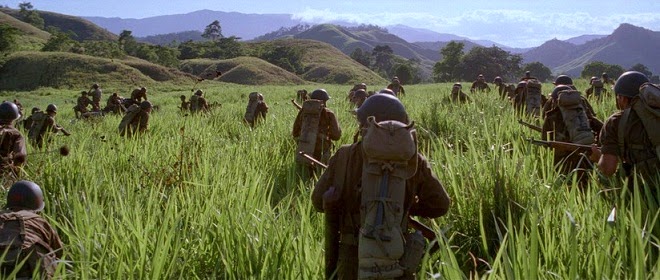
The Thin Red Line is an adaptation of the James Jones autobiographical novel from 1962, telling the story of the battle at Guadalcanal during the second World War, and to put it lightly it is an astonishing cinematic achievement. It was now after the 20 year hiatus that we start to see Malick's transition from using standard, easy to follow storytelling devices to more abstract work, as the depth and philosophical nature of the film is oozing with subtext to dive into rather than just a battle heavy, mayhem filled look at the horrific nature of war. This was my introduction to Malick back in the late 90's, and I don't recall how I really felt about it then, but I can safely tell you that I didn't truly appreciate it and determine it was worthy of the word masterpiece until I revisited after falling in love with The Tree of Life.


Oh, did I mention The Tree of Life again? Well I will address it once more, but briefly. It is the greatest film I have ever seen. It makes me feel like a small part of a huge world, which might sound like a bad thing but it really isn't. It is a film that helped me gain perspective on what it means to exist, on the beauty of being a husband and a father and having the chance to drive home every day and see those I love waiting for me on the other side of the door. The Tree of Life may be "just a movie" to many, and I am sure plenty of people hate it and I don't blame them. Hell, I did initially. For me though, it is a recognition that life itself is a miracle and I refuse to take it for granted.

The most recent Malick release came in 2013 in the form of To the Wonder, and it is yet another piece of abstract art that feels very similar to The Tree of Life although less grandiose and lacking that importance that can shake my core. I appreciated so much of the beauty of To the Wonder, which focuses on life, love and the nature of human relationships, but I didn't really feel a connection to it by the time it ended, which was disappointing considering the intense feelings I had garnered for the rest of his work by the time I got a chance to see this one.


Now at the age of 71, Terrence Malick is busier than ever before with multiple projects in the works, and I can't wait to see all of them. I am sure they will be divisive and abstract and bizarre, and that is why I appreciate the man so much. At a time when most cinematic experiences play it very safe and simplistic, Malick doesn't make films that will be universally loved and I doubt he is in search of such praise. What he crafts are films that are memorable, that promote discussion and debate, and will stick somewhere in your mind long after the screening is done, even if you hated it.

We need more minds like the one fueling Terrence Malick, although something tells me such a thing is rare, which is what makes him that much more special.

My ranking of the films of Terrence Malick:

1. The Tree of Life
2. The Thin Red Line
3. Badlands
4. Days of Heaven
5. To the Wonder

Not listed is The New World, the only film by Malick I have still not seen.


Tuesday, November 25, 2014

Genius Directors - Stanley Kubrick


Despite being a fan (to say the least) of Stanley Kubrick and his films, I didn't quite grasp the level of brilliance he achieved during his career until I visited his IMDB page recently and really soaked in the list of his work. The man was essentially a masterpiece machine, and what impresses me even more is that he wasn't a one trick pony who mastered a genre and stuck with it.

In 1957 he released the devastating film Paths of Glory, an anti-war story of a troop of soldiers who refuse to follow through with a suicidal attack and are thus charged with the war crime of cowardice, a potential sentence of death at the hands of their own country they trusted with their lives. In 1960 Kubrick was at the helm of the historical epic Spartacus, a film twice as long as Paths of Glory and far grander in scope. In 1964 the world was lucky enough to witness the absolutely brilliant anti-war satirical comedy Dr. Strangelove or: How I Learned to Stop Worrying and Love the Bomb, which I consider to be one of the greatest comedies ever released.


His next film after Dr. Strangelove is considered by many to be not only the greatest science fiction film of all time, but perhaps the greatest period. 2001: A Space Odyssey is without a doubt my favorite work of Kubrick and sits comfortably in my top ten films of all time, an abstract and polarizing cinematic behemoth that is designed to confound and challenge the audience, and it succeeds as even after double digit viewings I can merely present my hypothesis on the meaning of the film rather than absolutes.

Skip ahead all the way to 1980 when one of the truly iconic horror classics was released, The Shining, a film that not only scares the shit out of viewers but also has left a lasting legacy on pop culture and anyone who has allowed the haunting imagery to linger in their minds. Next was Full Metal Jacket in 1987, another Kubrick anti-war classic that plays in two jarringly different acts, the first at boot camp as we witness the mental breakdown of Leonard Lawrence, more famously known by the nickname Gomer Pyle, and the second act allows us to witness the awfulness of the Vietnam war. Full Metal Jacket is a wonderful movie as a whole, but the first act at boot camp and the final scene of the film are the two aspects that will forever stay with me.


Finally, twelve years later in 1999, sadly Kubrick's final and most misunderstood masterpiece was released, Eyes Wide Shut, a film that literally gave me nightmares after seeing it. If you sit down to watch Eyes Wide Shut because you are looking for nudity and the infamous orgy scene, don't bother. Sure, those aspects are indeed there, but if your main goal is to be aroused by the experience you are sure to be disappointed, as the narrative of this film is instead a giant advertisement for the positives of monogamy, a slice of cinema that left me feeling anything but sexy.

Amazingly, all these films I mentioned and I didn't even cover Barry Lyndon or A Clockwork Orange, considered to be two of the finer films ever released. That is how brilliant the filmography of Stanley Kubrick.

Ranking his work is a tall order, but here is my attempt to do so:

1. 2001: A Space Odyssey
2. Eyes Wide Shut
3. The Shining
4. Full Metal Jacket
5. Dr. Strangelove
6. Paths of Glory
7. Barry Lyndon
8. A Clockwork Orange
9. Spartacus

Not listed are those I have (sadly) never seen, his first feature from 1953 titled Fear and Desire, the 1955 film The Killer's Kiss, The Killing from 1956 and Lolita from 1962. A part of me feels ashamed to still have these four films to experience before I can truly understand everything the man accomplished, but the other part of me is thrilled to have Kubrick work left to discover.

Eyes Wide Shut Review


This was not my first viewing of Eyes Wide Shut but it nevertheless felt like an eye opening experience. After I finished the film very early this morning, I headed off to bed to get some sleep. With the window open next to me, I was sure I heard an ominous noise outside and I jumped to my feet to take a look. Nothing. Silence. I tried to convince myself that there was nothing to worry about, yet as I laid there I couldn't shake the feeling that I was being watched. I was certain that someone was out there, residing calmly in the darkness, waiting for me to drift off into vulnerability.

Once I finally did, I had a pretty vivid and disturbing nightmare regarding the safety of my loves one. I woke in a panic in the middle of the night, reminding myself that reality was still as mundane as our suburban slumber. It was merely a dream. Is it possible that these images that haunted my subconscious happened on this night, after this film coincidentally? Absolutely. I have no proof otherwise. Personally though, I believe I was soaked in the atmosphere Kubrick created. I believe I absorbed the paranoia of Dr. Bill Harford (Tom Cruise).

When this film was released in 1999, I recall it being touted as something that would be endlessly sexy, a dream come true for my hormonal 15 year old self. At the time I didn't appreciate what it really meant to be a Kubrick film, but had I known I wouldn't have believed the hype that this picture was meant to sexually arouse the audience. The irony of a work that features numerous nude women, prostitutes and an orgy is that in the end, it feels like a giant advertisement for the benefits of monogamy.


While not sexy, Eyes Wide Shut is without a doubt one of the creepiest films I have ever seen. I am seldom impressed by the horror genre, and such films rarely keep me up at night or make me consider the possibility that someone is watching me, but the hypnotic world created by Kubrick along with the simplistic yet utterly perfect musical score had my nerves fried, my stomach unsettled and my skin crawling, especially during the infamous mansion sequence.

I recall this film being deemed a lesser Kubrick upon its release, which was also the final work of the genius auteur. Perhaps a victim of a marketing campaign that wanted to focus on a beautiful real life couple doing sexy things together on camera, it seems as if those that entered the cinema initially had their perversions disappointed and thus couldn't connect to what was actually presented. Not only do I disagree with anything about Eyes Wide Shut being lesser, it very well might be one of the finest efforts from a man who seemingly crafted masterpieces with ease.


I doubt anyone was actually watching me last night as I attempted to count sheep. It seems absurd to even consider such a thing, but what proves the power of this work is that I still feel like I can't be sure. It may take quite a few more viewings to fully appreciate the density of this film, and perhaps every time I will lose a bit of a sleep that night. I am willing to embrace the nightmares.


5/5

Friday, November 21, 2014

Spirited Away Review


If you are not familiar with the work of the legendary master of animation Hiyao Miyazaki, look up his filmography and start from the beginning. Actually, it would be a safe bet to just watch every film released by Studio Ghibli, which Miyazaki co-founded in 1985. While not every movie released by the studio has been flawless, in general the production company has put out some wonderful, imaginative work, and in my opinion their two greatest achievements are two of the finest in the history of animated cinema: My Neighbor Totoro and Spirited Away.

Spirited Away is, quite simply, an incredible piece of art, one of the finest, most detailed examples of why hand drawn animation will always burst to life in a way that computer animation is unable to. I could pause every frame of this film and admire the remarkable craftsmanship that went into it's production, as even the smallest detail in the farthest corner of the screen was treated with importance and care. My seven year old daughter sat in awe of every single minute of Spirited Away and I was right beside her feeling that same sense of wonder all over again.


Spirited Away tells the story of a 10 year old girl named Chihiro and her parents as they are on their way to their new home, but one wrong turn has them exploring an abandoned amusement park instead. The magical, mystifying world Chihiro finds herself in soon after cannot be explained by my words, and really it shouldn't. You just need to see it for yourself, but every moment is full of imagination and creativity and thematic richness that hides behind a simple tale of a young girl trying to find a way back to her parents and the world she knows.

There is a scene at one point that takes place on a train, and I don't mean to build it up as some major action packed event because it isn't. Very little technically occurs during this sequence, and yet it may be my favorite few minutes of any animated film ever. The music, the beautiful animation, the fact that the surreal scenery reminds me of a dream I once had and wish I could have again...it all adds up to pure perfection. It is a small segment of the film, just a few minutes, and it is sublime in its simplicity.


I will continue to waffle on whether My Neighbor Totoro or Spirited Away is the true Miyazaki masterpiece, but honestly it may be a tie, and that's not so bad right? Why pick one when you can watch both?

If you haven't yet, do it. Watch them both. You won't regret it.


5/5

Saturday, November 15, 2014

The Passion of Joan of Arc Review


In a review posted in 1997, Roger Ebert wrote "You cannot know the history of silent film unless you know the face of Renee Maria Falconetti." What makes this statement fascinating is that anyone even remotely familiar with that era of film would think first of the stars of the time like Charlie Chaplin, Buster Keaton and perhaps Harold Lloyd, yet he invokes the name Falconetti as a necessary piece of cinematic knowledge. Was she a star at the time, a familiar face recognized from multiple silent classics? She was not. In fact, her lead role in The Passion of Joan of Arc was her one and only appearance on film during her life. It didn't require her to speak a single spoken line of dialogue, and yet it may just be the greatest single performance ever put to celluloid. 

Never has emotional anguish felt so real than in the eyes of Falconetti, which combined with the brilliant direction from Carl Theodor Dreyer makes this film a haunting and disturbingly beautiful experience, one of the few I can honestly categorize as feeling religious in nature. I am not a church going man, needing factual proof rather than faith to devote my life to any higher power, yet I get so lost while watching films like The Passion of Joan of Arc, The Tree of Life and to a slightly lesser extent the phenomenal Life of Pi that I can't help but wonder if some sort of unseen force was working behind the scenes, allowing such powerful themes to flourish in a motion picture. 


You can't simply watch a film like The Passion of Joan of Arc. If I had made popcorn prior to the start of the film, it would have been left untouched. If I had put too much ice in my soda, it would have been watered down by the time I took my first sip. The imagery in play during this absolute masterpiece from 1928 combined with the breathtaking "Voice of Light" musical score that was added to the film in 1994 by composer Richard Einhorn. While it might seem strange to watch a film released nearly sixty years before my own birth featuring music that wasn't even composed until I was already ten years old, you must understand that when the film was first played for audiences in the late 20's, it featured music played live in the theatre by an orchestra. Those compositions and whether or not a definitive piece was ever chosen to accompany it is unknown, but music was always involved in the film, and "Voices of Light" is an achievement so grand it is worthy of being played along side the work of Dreyer.

This was my second viewing of The Passion of Joan of Arc, and my decision to place the film in my top 5 of all time after a single screening has been proven justified. Occasionally I am guilty of making proclamations of greatness that prove to be hyperbolic, and I am willing to admit that initial excitement and my passion for the medium got the best of me, but that simply isn't the case here. In fact I am wondering if perhaps I am underrating this film, because honestly, it just might be the greatest film ever made.


5/5