Thursday, July 31, 2014

The Purge: Anarchy Review


Despite finding the first Purge film from a year ago to be terrible, I still had some hope that a sequel could find its footing and deliver everything that the first was so painfully lacking. The problem with the first film is that its own concept raised my expectations, an idea that on paper sounded like it could be fascinating if done correctly. Right off the bat my mind was racing with thoughts regarding why the society I occupy would want or need such a day, as the human psyche and its confounding thirst for bloodshed are things that I cannot understand. I gave the vision of the unknown James DeMonaco far too much credit, expecting him to take a detailed approach to studying the troubling nature of an annual purge and why as a society we cannot strive for a crime free, peaceful world. I mean, its great that crime is down the rest of the year and the economy is thriving, but is it ever a good time to allow atrocities like rape and murder happen to innocent people?

I sat down last year, expecting a film full of chaos and murder on the surface, sure, but I had hoped for some rich subtext, some meaning to the message of the film. Instead I got 90 minutes of Ethan Hawke walking around in the dark bumping into things while a Patrick Bateman impersonator attempted to break through their oddly ineffective security system. A brilliant and unique concept wasted on one home, one family, with zero substance to absorb from the experience.
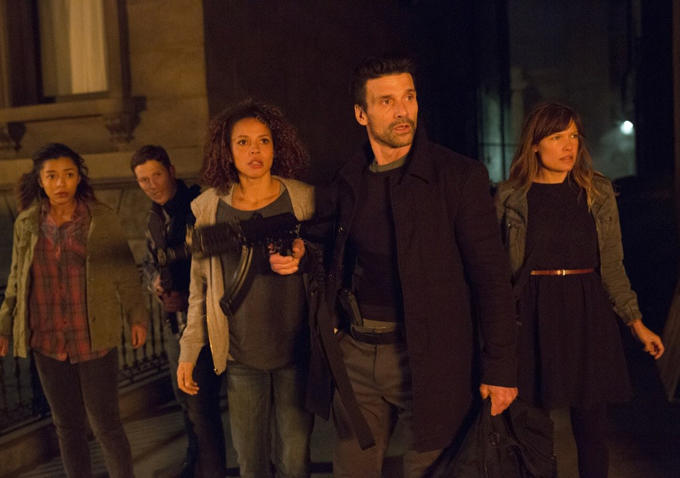


A year later and it is time again for the annual purge, and with it comes the possibility that DeMonaco caught wind of the negative feedback that plagued his first effort regarding its limited scope and poor execution. Perhaps the fact that the trailers and advertisements I saw in advance of this viewing showed the devastation of the lawless night taking place out on the streets, following various characters literally navigating the dangers simply trying to survive each minute as it ticks away before order is restored, meant that the minds behind this film had heard and understood these complains and thus expanded the scope and narrative to their full potential. Unfortunately, this sequel proved to be just as big of a failure as the first film. It just took a different path to get there.

What amazed me the most about The Purge: Anarchy is the fact that it is a 90 minute film about people in masks wandering the streets with deadly weapons trying to kill everything that moves, and yet it is so excruciatingly boring. I wasn't tired as I screened this last night so the fact that my eyes continued to leave the screen over and over again cannot be blamed on my lack of focus. I was craving an interesting film experience last night, I was so in the mood to be entertained and yet I was left daydreaming about things I could have been doing in that moment that would be more fun, and that list would be plenty long if I were to actually put it together. A lively, fantastically fresh concept yet again dies with bland cardboard characters and meaningless set pieces that feel like an exercise in merely moving from point A to point B rather than achieving anything memorable to grab onto.

"Uh oh, it's those guys! Let's go over here!"

"Now we are over here and those guys look pretty mean too! Let's go down this alley!"

"Uh oh, it's those first guys again, and boy are their masks creepy! Watch out!"

^ This is essentially the entire film until my brain nearly died and I had to take a step away for a moment to regroup.


Also, they present these "bad guys" as if they are creepy and disturbing, but they really aren't. They are just as bland as the gaggle of protagonists that we follow throughout, the film is screaming for some sort of charisma which, to be fair, Frank Grillo comes close to providing as at least he delivers some lines with conviction and manages one or two moments that are capable of putting a smile on your face amongst the otherwise dour and pointless events. Otherwise though, zero percent of the remaining cast do anything to captivate or keep someone invested in the "story".

Eventually the film attempts an on the nose commentary about rich people and their treatment of those they deem lesser, which would be interesting except it is essentially exactly the same as the first film when they trust fund killers follow the homeless man and feel it is necessary that they kill him. We get it, the 99 percent are being slaughtered by the 1 percent because money equals power. Whatever, just finish this shit up so I can eat a fruit roll up in bed while watching a sitcom rerun.


Until now, I had hope that this unique concept could bring an excellent film to the screen. Unless it gets rebooted by someone down the road with actual talent, the entire Purge franchise is a shameful waste of something that could have been special. I'm already bored just thinking about a third installment.


1/5

Monday, July 28, 2014

A Man Escaped


A Man Escaped is my first ever Robert Bresson film, and what an incredible way to start. I had no idea how literal the title would be here, as this truly is a story about a man trying to escape from start to finish, a work that thrives because of its minimalism rather than in spite of it.

I have no idea what the typical Bresson style is and whether or not this film represents it, but I really appreciated the fact that throughout the entire work the focus stayed nearly primarily on the lead Fontaine besides a brief conversation or two amongst other inmates, but even then he was the basis of their words. Much of the film not only follows this one man on his quest to escape from prison, it takes place in the claustrophobic setting of his cell and you can really feel the confinement as you watch these sequences.

After Fontaine discovers his less than ideal fate at his sentencing, the film introduces a new character that as a plot device is a stroke of genius, a cellmate for our protagonist which is a far bigger obstacle than simply being an intrusion into cramped quarters. How does one continue with their solo plan for escape when an unknown presence enters the situation, able to see their every move?


I am guilty of being a film optimist and I am aware of this. I can't help it, while some are able to delve far deeper into a narrative and pick up the smallest of flaws, I will often times forgive these minor errors. After all, no film is truly perfect, right?

A Man Escaped might be. I'm not sure of this, how could I be sure of this? It certainly feels perfect though. Looking back at every second of the film, I can't think of a single moment that didn't feel exceptional and inspired. The final act in which the escape attempt finally takes place is a sublime example of building tension, and how it is achieved makes it even more impressive. As I slid forward to the literal edge of my seat, I realized this wasn't due to a musical score that was striking a chord with my nerves or frenetic editing to keep us updated on the movements of every guard on duty that could stand in the way of freedom. No, Bresson keeps the camera glued to the movements of Fontaine for most of the escape and we follow the potential threats by simply hearing their footsteps or the squeaking of a bicycle moving past. A truly brilliant example of the potential of cinema.


I consider many, many films to be great, but A Man Escaped is something special.


5/5

12 Monkeys Review


I find really strange coincidences to be fascinating, which is why I can't seem to get over the one I experienced the other day when I was picking out films to watch at the library. I don't believe I ever knew that La Jetee was the inspiration behind the production of the film 12 Monkeys, I honestly don't recall ever hearing such a thing. Perhaps I did, at some point in time years ago and it subconsciously stuck with me, but I doubt it. So I grabbed La Jetee from the DVD section because it had been recommended to me recently, but again, with that recommendation there was no mention of 12 Monkeys, which I just so happen to walk over to the Blu-ray options and spot only moments later, adding it to the glorious pile of completely free film residing in my arms.

It wasn't until after I finished La Jetee and fell head over heels in love with it that I did some reading up on the history of that work, only to see 12 Monkeys get brought up in relation to it time and time again. While this wasn't technically my first ever viewing of Monkeys, it has been so many years between them that I could barely remember the plot of the film, let alone whether or not I enjoyed it. The fact that I was able to see the masterful short film first was a huge benefit for me entering this long awaited revisit because with the inspiration still fresh in my mind, I was able to truly appreciate that this wasn't some attempt by Terry Gilliam to remake a classic or try to improve upon a film that may have desperately needed an expansion or upgrade of the narrative. 12 Monkeys is a fantastic science fiction work that shows the utmost respect to what inspired it to be, using the incredible concept and conclusion of the flawless short film and building onto and around it with a surprising confidence and ease. Typically I dread the idea of a filmmaker finding a way to even remotely connect their own work to a true cinematic classic because the results can only fail when forced to shine in such a bright, massive spotlight. What Gilliam achieved here was brilliant, because he both tipped his cap to a science fiction masterpiece that was released 33 years before it while somehow also crafting a work that felt remarkably fresh and original.


The way the usage of time travel allows the plot to unfold is extraordinary, allowing us to encounter a unique blend of characters and set pieces that constantly keep the film feeling exciting and alive. The performances across the board fit the tone of the work beautifully, but this is not just an example of familiar faces giving us their best. This is a testament to how important the aspects of creating a film that occur behind the scenes are, the incredible importance of the words on the pages that are being delivered, the inspired casting choices that brought the best possible vision to the screen, and the art direction and cinematography that delivered such appealing, bizarre visuals throughout.

I could get used to a La Jetee/12 Monkeys double feature every so often, revisit the original work of art that proved to be so influential it literally is the reason why the latter even exists in the first place. Gilliam deserves to be commended because not only did he avoid a potential train wreck by connecting his work to such a beauty, he actually created a film that is almost just as good.


4.5/5

Friday, July 25, 2014

La Jetee Review


I have never understood the fascination with the nostalgic power of photographs. I encounter so many people who have an obsession with documenting every banal moment of their lives with pictures, stopping in their tracks to pose outside a frozen yogurt shop or while they are eating a slice of pizza. The worst part is that they think I care, but I don't. Don't show me 150 still images of the same seven people smiling at a camera from different angles. Don't even show me one of those images. Being totally honest, zero percent of me cares to see the picture and zero percent of me cares to be in such a picture. All I need is my memories, whether they be of the most mundane, seemingly insignificant segments of my life or of a monumental moment that changed everything.

I had absolutely no idea what style of storytelling would be portrayed during the much lauded 1962 science fiction masterpiece La Jetee, and I was surprised to find that essentially it is my worst social nightmare presented cinematically. For a brief 28 minutes, an entire narrative is presented almost exclusively through a series of still images and a voice-over, and my goodness is it incredible. Telling the story of an attempt to time travel after the ramifications of nuclear war left Paris devastated, I was completely captivated by the format of the film and floored by the results. 


The most fascinating and important slide show of photographs I have ever witnessed. If only my family and friends could present their weekend getaway in such an inspired fashion.


5/5

Thursday, July 24, 2014

Inland Empire Review


David fucking Lynch. Seriously.

I was considering waiting a bit to figure out what in the hell to say about his surreal 2006 masterpiece Inland Empire, but I can't just walk away from the opportunity to put some words down while the work is still fresh in my mind. This freshness is also the downfall of my ability to form coherent thoughts though, because honestly, I have no damn clue what I just watched. I don't. Why lie about it? Why pretend like I was able to peel off the many, many bizarre layers of this film, like I have any earthly idea what was going through Lynch's mind during the creative process that spawned this picture? 

I have had intense, confounding nightmares that have haunted me less than the imagery presented throughout this film. I absolutely will not go search for meaning from whatever it is I just witnessed. I wouldn't possibly risk ruining this feeling, like I just observed both a cinematic miracle and an abomination to the medium during the same three hour film. I'm sure some out there would absolutely consider a work like this to be the latter, a pretentious (a word I friggin' loathe) clusterfuck of meaningless images without a comprehensible narrative to follow. I tend to lean more in the other direction.


The irony of surrealist cinema is that while it takes a genius to craft something as spectacular and baffling as Inland Empire, it is mandatory for me to use as little of my brain as possible while I watch it. I want to soak up all the aspects that are made apparent, the incredible imagery, the vivid cinematography, the downright scary performances, and the musical score that suits the haunting tone of the entire work, but as for trying to piece together any sort of message of the narrative, the deeper meaning of every single scene, putting too much effort into understanding does more harm than good. If I am able to have a visceral reaction to the film, if I am fascinated by what I am seeing to the point that looking away feels like a crime, than I know I love what I am seeing. 

I was endlessly fascinated by Inland Empire, and I couldn't look away.


5/5

Peeping Tom Review


Frankly, I love watching perverts in action.

Let me clarify what I mean by love. While I am watching a film like Peeping Tom, an excellent work from 1960 by director Michael Powell, I'm not in my living room cheering on the troubled subject in the film, nor am I finding some sort of unsettling sexual satisfaction due to their actions. No, when I say love in this regard I simply mean that I am completely fascinated by character studies of this manner and the tone of such films typically works wonders for me.

Despite my preconception to embrace such a film, absolutely nothing is guaranteed once the first frame appears on screen. Plenty of films have dabbled in the world of perversion and deviant sexual behavior, so it isn't some new subject matter that will automatically keep me invested. When it all comes together though, when cinema is willing to dive head first into the darkness and swim around with depraved, disturbed characters, those are the types of films that I mark on the calendar and count down the days until I have the opportunity to lay eyes on such a work.


Peeping Tom is a wonderful example of how good it feels to explore the depths of evil.

Right off the bat I knew I was going to admire the film when it kicks off from the perspective of looking through someones personal camera as it approaches an unsuspecting woman on the street. It is amazing how effective this technique is compared to simply filming a man approaching a woman in an ominous way, because the first thing I thought of was how delightfully wrong it all felt. Only a few minutes into a film and this voyeuristic approach had me feeling uncomfortable thanks to the enhanced realism, as if a work of fiction had been transformed into a documentary I shouldn't be watching.

An even bigger credit to this aspect of the film is that it isn't any less jarring as the narrative progresses and the technique is used repeatedly. In fact, it becomes even more unsettling once we witness the initial murder first hand because after that moment, even if we seem to be watching something fun and innocent, through this lens it is dripping with danger.

The casting of Karlheinz Bohm as the lead was an inspired choice. In fact it is downright perfect because his look alone fits the bill of exactly what scares me the most about the concept of a peeping tom. Bohm as Mark Lewis is just normal enough for him to blend in and even earn the trust of his peers, yet he also emits the absolute right amount of creepy to make you wonder about him in the back of your mind, even if for just a split second. We learn as the film progresses that while we technically can never be 100 percent sure of whether he was born with a level of evil lurking inside his soul, it is clear that the very unhealthy and downright off-putting relationship with his father is what brought his perversions to the surface. Through various psychological experiments conducted to study fear and the nervous system, along with the observation that his old man embraced his desire to film moments worthy of privacy, Mark Lewis became the man he is today, a man that I hope to never encounter, a character realistic enough for me to realize I unfortunately just might.


Peeping Tom was released 55 years ago, and it seems to be a work that was ahead of its time. Released during an era where such topics were controversial, the film was initially trashed by critics and the career of director Michael Powell went off the rails as a result. Seeing it now, I admire the fact that what was crafted so long ago isn't even remotely dated, playing even more relevant today as we are still attempting to understand the intricacies and terrifying realities of mental illness and sexually charged crimes.

A great film that deserves the credit it finally earned over time.


4.5/5

Tuesday, July 22, 2014

Robocop Review


When I was a teenager, I wasn't exactly what one would call a "ladies man". I didn't have the confidence, missing opportunities for adolescent romance because the fear of being rejected far outweighed the potential benefits of success in my mind. On some random night during high school I recall watching RoboCop and while I didn't pay close enough attention to the film to truly appreciate the brilliance of the satire (I was likely drunk, high or both), I do recall being captivated by the theme music in the film. I started imagining what it would be like to have it start playing just before I entered a room. I could have been forty pounds overweight wearing a stained t-shirt and pajama pants, doesn't matter, the RoboCop theme would have transformed me into a sexual icon.

It took me being an adult to finally "get" Paul Verhoeven. While I never took this film too seriously, I used to deem that as a flaw of some sort, as if the silly over-the-top performances, advertisements and news segments were unintentionally comical. In my younger, naive mind, I believed that Verhoeven was attempting to craft a super serious action film and got lost along the way. Now that I have had the opportunity to sit down and experience this film with a clear, semi-intelligent mind, I am ashamed of the limited scope of my past film appreciation potential. I can't help but wonder how many films I "watched" during that era had unfortunately soared over my head.


What I once deemed as merely silly, I now admire for being so friggin' smart. RoboCop is everything you could ask for from a science fiction/action film. It has laugh out loud worthy wit, thrilling action sequences, and yet still plenty of warmth and emotional resonance to establish a true connection with the audience. Mastering one aspect only would have still been enough to entertain and earn my recommendation. Had RoboCop been only successful as a brilliantly on the nose social commentary, I would have enjoyed it. Had it been merely an exciting action film with some inspired set pieces, I likely would be able to shut my brain off for 90 plus minutes and reveled in the violence. The fact that Paul Verhoeven managed to balance every possible direction the film could go with seemingly flawless confidence, that is why RoboCop stands today as a 1980's genre masterpiece rather than just another film lumped in the massive group of entertaining but forgettable films that were released around the same time.

Today I live life as a loyal married man, but my desire to claim the theme music as my own remains unchanged. Sure, my days of being an overly horny and lonely teenage male are long over, but the song is simply too fucking epic to ignore regardless. In the near future I will drive to work one morning with it blasting from the speakers in my car, and anyone of importance in the office will take notice. It may not guarantee a raise and a promotion, but it certainly can't hurt, right?


5/5